Since our most recent issue, people in our Balkan camp community have announced the following new releases.
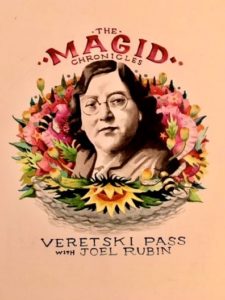
Veretski Pass, with Joel Rubin, has embarked on uncharted territory with their new project dedicated to performing the pieces collected by Sofia Magid, the Jewish ethnographer who worked intensively to document Jewish music in Belarus and Ukraine during Stalin’s regime in the 1920s and 30s. Magid’s 600 recordings include music that was not only collected by a woman, but that also features rare examples of women’s themes. Veretski Pass’ and Joel Rubin’s work involves cleaning, deciphering and transcribing the dubs of the cylinders, then arranging, performing and recording them and finally teaching them to workshop students.
An important facet of the project is the cadre of new compositions, improvisations, and re-compositions derived from and/or inspired by the Magid collection and drawing on traditions and cultures as diverse as Romanian, Turkish, Greek, and Hutsul traditions. Although derived largely from ethnographic work, this work is essentially a creative reimagination of the material.
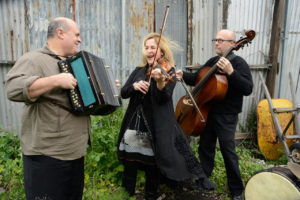
Taking its name from the mountain pass through which Magyar tribes crossed into the Carpathian basin to settle what later became the Austro-Hungarian Empire, Veretski Pass offers a unique and exciting combination of virtuosic musicianship and raw energy that has excited concertgoers across the world. The trio plays Old Country Music with origins in the Ottoman Empire, once fabled as the borderlands of the East and the West, in a collage of Carpathian, Jewish, Rumanian and Ottoman styles. Cookie Segelstein - violin; Joshua Horowitz - chromatic button accordion, cimbalom; and Stuart Brotman - bass.
CD, $15, available here.
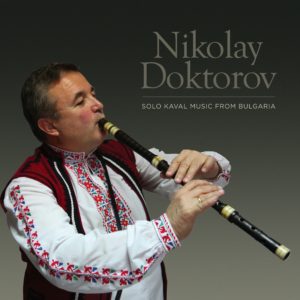
Steve Finney, Dan Auvil and Jerry Summers have assembled an exceptional and professionally produced CD of solo kaval music by Nikolay Doctorov, who has been the kaval instructor at many EEFC Balkan Music & Dance Workshops. Some of the material has been released before, but the sound has been cleaned up. All tracks are completely unaccompanied kaval, including dance tunes and slow melodies, with a balanced combination of traditional style and many original compositions.
Available at cdbaby.
David Bilides and Dragi Spasovski have just released the 39th podcast in their series, “Macedonian Postcards,” which features the song “Dva mi brata verno živuvale,” a song from Ovčepole about family animosities, from Carka Tasevska, who also recorded with his mother.
Since the first podcast in 2007, David and Dragi have discussed and provided samples drawn from the 54 Macedonian folk songs in Dragi's three-CD project issued by Izvor Music. On each podcast, Dragi tells stories about the recordings and musicians and gives glimpses of his life and Macedonian culture in general. You can download each episode individually, listen to an audio stream of each episode, or subscribe to the entire series.
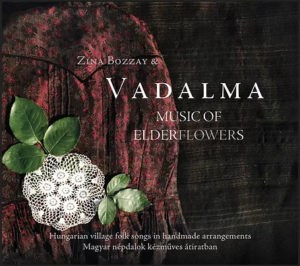
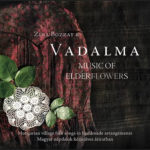
Vadalma (“Wild Apple”) creates vibrant, intimate settings of Hungarian village folk songs, featuring the rich singing traditions of Transylvania, Moldova, Transdanubia, and other areas of the Carpathian Basin. These striking melodies, unique rhythms, and colorful lyrics are framed with both traditional and original accompaniment. Zina Bozzay - voice, arrangements; Matthew Szemela - violin; Misha Khalikulov - cello; with special guests Fábián Éva - voice, ütőgardon; Navratil Andrea - voice; and Agócs Gergely - Transdanubian long flute.
Vadalma learns all of their repertoire directly from last living village singers and archival field recordings, and has collaborated in shared performances with numerous musicians from Hungary. More info at www.zinabozzay.com/vadalma
$15 - order here

 A five-piece ensemble from Boston, Mass., Cocek! Brass Band plays music influenced by Eastern European and New Orleans dance songs, Afrobeat, Klezmer and elements of reggae and Western classical pieces.
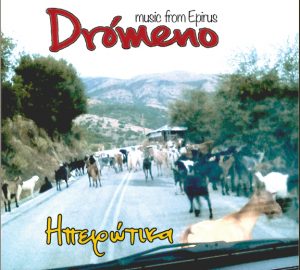 DRÓMENO is a Seattle-based traditional ensemble presenting regional folk music from the Greek mainland and beyond, overlapping into the surrounding regions and finding the musical legacy that connects the traditions of the Balkans. This CD of music from Epirus features Christos Govetas – clarinet, voice; Ruth Hunter – accordion, voice; Nick Maroussis – laouto, electric guitar; and Eleni Govetas – violin, defi, voice.
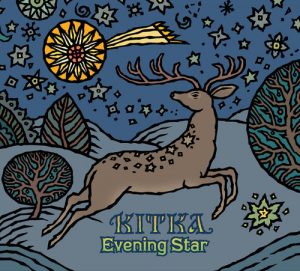 Now celebrating its 39th season, Kitka is an American women’s vocal arts ensemble inspired by traditional songs and vocal techniques from Eastern Europe. Dedicated to developing new audiences for music rooted in Balkan, Slavic, and Caucasian women’s vocal traditions.
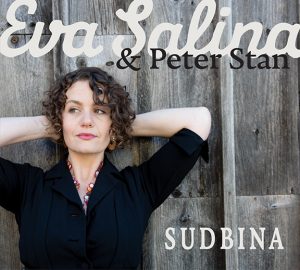 Eva Salina & Peter Stan announce the release of their new recording, SUDBINA: A Portrait of Vida Pavlović.
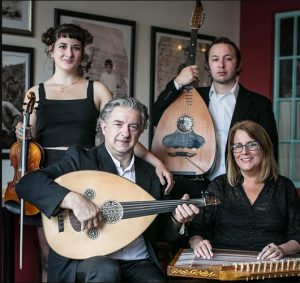 “When I was a kid in Greece,” explains Christos, “in the hot long summers after we’d bring tobacco we had collected from the fields to the shed where we’d needle it and string it to dry (a copious and tedious work), there was Simon Karas’s two hour radio program from 3:00-4:00 in the afternoon with all those incredible recordings, some of which were from Epirus.”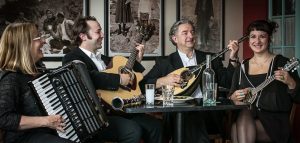
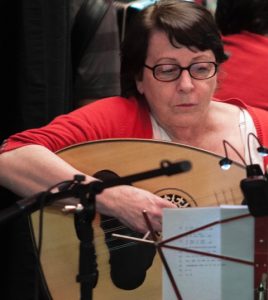 Joan Carol Friedberg has been passionate about Greek and Balkan traditional music since she first heard it in the 1970s and has traveled throughout the Balkans and to Greece many times to experience it firsthand. She currently plays laouto with the Los Angeles-based Greek band Sto Horio. She is author of